.png)

Football Season!!! Here is Your Winning Game Plan!
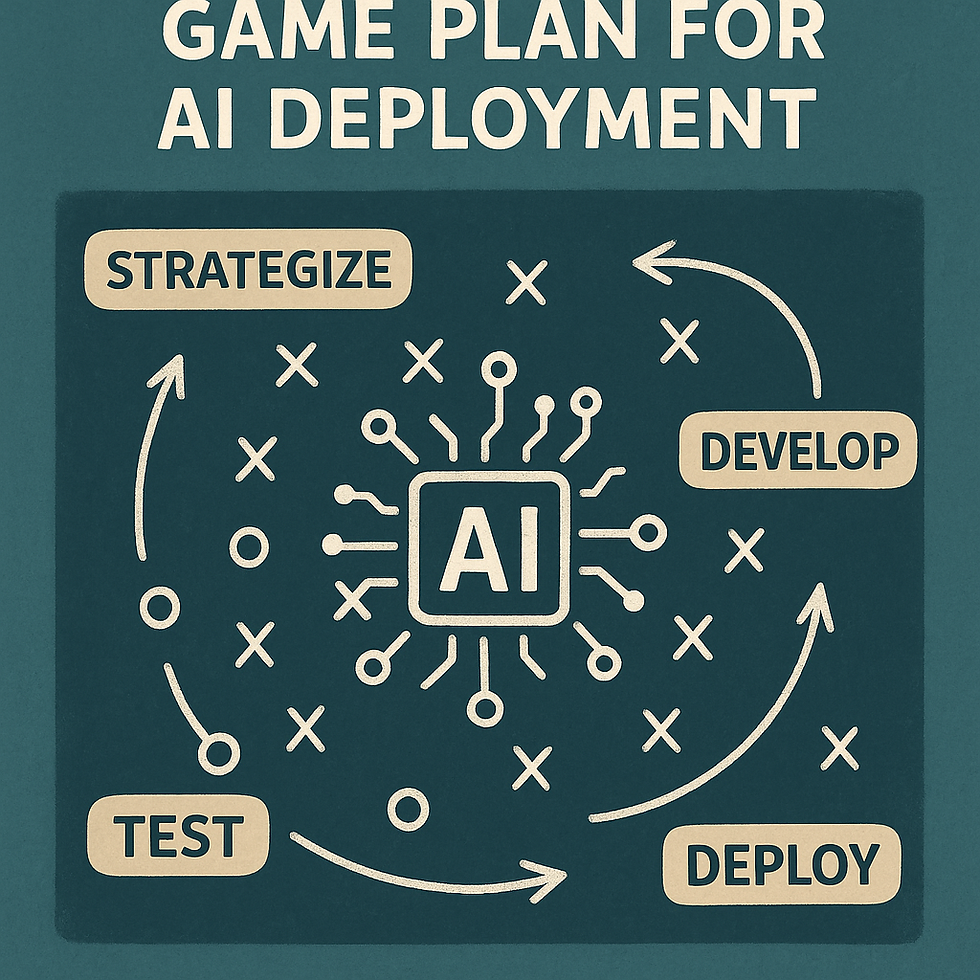
The AI Game Plan: How Leaders Structure AI for Competitive Advantage
As football season gets into full swing, it’s a timely reminder that success—on the field or in the boardroom—rarely comes from improvisation. It comes from a disciplined game plan, well-defined roles, and an organization aligned around execution.
The same is true for AI.
Across research from McKinsey, Deloitte, MIT Sloan, and HBR, one finding is consistent:Organizations that structure AI as a core business capability are pulling ahead. Those treating it as a technical experiment are falling behind.
Here are the five elements high-performing organizations are building into their AI playbooks.
1. Begin With the Scoreboard: Define the Business Outcome First
Executives who win with AI start with the scoreboard—not the playbook.They identify the KPIs that matter and design AI around those outcomes.
Not: “Which model should we use?”But: “Where can AI deliver measurable business value?”
This shift ensures AI isn’t a side initiative. It becomes a driver of revenue, efficiency, and customer experience.
2. Build a Scalable Operating Model, Not One-Off Projects
Championship teams rely on systems. So do AI-driven enterprises.
Leaders are establishing:
A central AI function to define standards, platforms, and governance
Embedded AI product owners within business units
Integrated processes where people and AI collaborate in real time
Clear accountability for results
This is how organizations move from isolated pilots to enterprise-level impact.
3. Strengthen the Foundation: Data, Integration, and Security
Trying to scale AI without a strong data foundation is the business equivalent of losing the line of scrimmage.
Executives succeeding with AI invest early in:
Data quality and accessibility
Integration across critical systems and workflows
Security, privacy, and compliance frameworks baked into the architecture
AI becomes more predictable, reliable, and impactful when the underlying structure is solid.
4. Institutionalize Governance & Responsible AI
High-performing organizations treat governance as an embedded discipline, not a compliance checkbox.
Modern AI leaders implement:
Clear policies and usage boundaries
Human-in-the-loop oversight where needed
Transparent logging, monitoring, and drift detection
Defined accountability across risk, compliance, and ethics
This strengthens trust internally and externally while reducing operational and reputational risk.
5. Develop Talent and Redesign Work Around AI
AI’s effectiveness is determined by how well teams use it—just as a playbook is only as strong as the players executing it.
Forward-thinking leaders are:
Equipping teams with role-specific AI training
Redesigning workflows to maximize human + AI collaboration
Creating feedback mechanisms for continuous improvement
Treating AI as a product with a roadmap, not a project with a finish line
This is where organizations create sustainable competitive advantage.
Closing Thought
In both business and football, the teams that win are the ones with a clear strategy, a disciplined operating model, and alignment around execution.
AI is no longer optional. It’s now part of the competitive playbook.
The question for every senior leader is simple: Do you have an AI game plan built for winning—or are you still improvising?
If you’re designing or refining your organization’s AI strategy, I’d welcome a conversation.Let’s architect something that moves the scoreboard.
#AILeadership #ExecutiveStrategy #DigitalTransformation #EnterpriseAI #BusinessPerformance #ResponsibleAI #CLevelInsights #OperationalExcellence #InnovationLeadership #FutureOfWork #CompetitiveAdvantage #AIAdoption #StrategyExecution #BusinessTransformation #LinkedInLeadership


Comments